Monday, May 2, 2011

Charged for just one more

During our most recent future-focused trip to Africa, we visited 8 orphanages and programs. It was invigorating to see our Ambassadors at work, implementing ideas to give our youth a true chance at a brighter future. Here's a little peek into the homes we visited.


Samson, Naibor Kenya

By evaluating each child on a case-by-case basis, identifying tangible education/career goals, and helping our youth view life beyond the orphanage as a positive place, we are able to help them become contributing members of their communities. Our Ambassadors are committed to helping each child reach their full potential.


Miriam, Naibor Kenya

The boys of the Timau Home
Thanks to our HALO Heroes, our scholarships have given hope to the children we support. HALO kids are now able to reach their dreams beyond the home by going to vocational school or college.

Alice, Uganda


Bukesa, Uganda


HALO Ambassador Dani Walker with Girls Home Mentors in Uganda

Josh Fry, Halo Volunteer and Eunice in Kenya


Every time I go, I come back saying the same things. 1)  Words cannot express how grateful the children are for our support. 2) I am incredibly charged to work toward a goal of bringing in one more child from the street... and another... and another. If we put ourselves in the shoes of a child on the street, we have profound drive to work on their behalf. This drive is what keeps HALO going and growing. 


Friday, April 29, 2011

Spark...The ArtReach Auction

It was the spring of 2006. We had been in existence for almost a year and a half and HALO was housed in a tiny room of my apartment in Kansas City we were supporting a few orphanages at that time. My roommate Sunny and I held meetings at a garage sale table in our place. We asked almost every person with whom we came in contact to be part of HALO and soon we formed a powerful team.

All the while, artwork from the children in orphanages was delivered to our door every time we turned around and soon enough there wasn't enough space for it all. Spark. The Artreach Auction. Why don't we auction these pieces off? The stories of their lives are expressed in these pieces. We should share them. It will connect our donors. 

Timau Orphanage, Kenya

Our first Ambassador Board came together for nothing short of a miraculous feat in 6 weeks. Volunteers stayed up all night at our place making frames for pieces, putting together silent auction baskets, painting huge flowers that would decorate the room. Since we had a $0 budget, our community donated  the food, the cocktails, the printing donated, almost everything. 
HALO Volunteers Marshall, Sunny, and Monica at 2007 Artreach Auction

I remember walking on the auction stage that night with the first piece of HALO art. I knew it cost $12.50 to frame that piece. I said a little prayer - please, please let someone pay at least $15 just so we cover our expenses. It went for $250. I screamed. We raised $35,000. It was magical.

Fast forward to today. We are supporting 13 homes and programs around the world. We have received thousands of pieces from the kids over the years, expressing their lives, dreams, and realities. To date, The Artreach Auction has raised hundreds of thousands of dollars and been held in 3 cities for over 2000 guests to enjoy. Nationally known artists have joined by donating their work to our cause as well. There are hundreds of walls in homes around the U.S. adorned with HALO artwork and a story that goes with each. 

Vera Von Holdenberg, 2009 HALO Artreach Auction


At this event, our supporters get a peek into the lives of the children they support; what life is like in their shoes. We want our donors to be connected to their good works and to watch HALO kids, who have a better life because of them, grow. The 13th HALO Artreach Auction will be held May 6th, 2011. Join us for a magical evening. We are expecting to sell out. Click here to come take a peek.


Wednesday, April 6, 2011

Future-Focused in Uganda


“I am a good candidate for a scholarship because of my academic performance in past years and I have the potential. I value education so much, and, according to me, in this global village many successful people have toiled with education and have achieved the best in their lives. Therefore, I also want to work hard to become the best and fulfill my expectations in the future. Furthermore, my personal goal is to become a good example to the younger generation.” Joel Batte

Joel Batte, HALO Hero Scholarship Recipient

What does it mean to be future-focused? According to the book "The Time Paradox", for future-focused people, long-range goals fuel today's decisions and actions. This keeps them ambitiously working, saving, and planning for a better life. Self-discipline and the ability to delay gratification are key. Future-focused people are more successful professionally and academically.  You need safety and stability in the present to start thinking about the future. 

Diner time in Uganda

My recent trip to Uganda was all about our future with questions such as: How will we maintain our programs in five years? What is the most responsible way we could bring in the other100 identified children in need? Who will our children become beyond the home? 

The Makarere Home, Uganda
For HALO, first we need safety and stability. This means we must secure sustainable funding through monthly donations or multi-year commitments to our programs. Then we are able focus on our programs, which must be geared toward giving our kids the tools to become contributing members of their communities.

Joel Batte is an example of a future focused youth who grew up in the Makarere Home in Uganda and just received the HALO Hero Scholarship. We want to follow Joel's example and continue to plan for the future. That way we are able, planning, and expecting to improve the lives of more children in need. We can all learn from Joel. I know he will be a great example for my personal life...

Monday, March 14, 2011

Who's on first? The catcher.

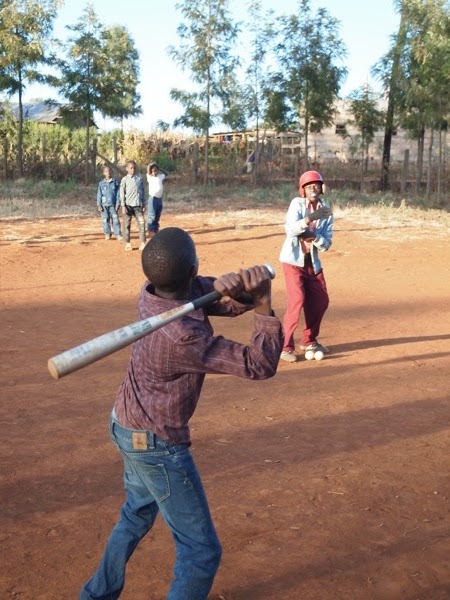
The last trip I took to Timau, I thought it would be a great idea to teach the kids how to play the game of baseball. A kind man from Kansas City donated some bats, balls, helmets, and catchers gear. While packing my over-sized suitcase I slowly realized that it may be a bit difficult to lug this around Africa and could have been smarter to just bring some soccer balls. Or how about teaching them flag football? Too late.
First Baseman
I really didn't think about the challenges. I set up the bases and thought it would be quite simple. After I explained the game, I thought we should be good to go. Well, we had quite a few issues: they would hit the ball and run past the base out into the field or just run around the bases over and over and everyone would just laugh or not understanding what "out" meant. After a few days of playing, I felt like they finally got it. They looked like a MLB team, well, except for the fact that most were barefoot and our bases we sticks in the ground. But they got the rules for the most part.
3 guys playing 2nd base, pitcher with batter's helmet

During this trip the kids were so excited to play baseball again. They got out all their gear and set up all proud to show that they could play the game. They had made a few minor changes: 1) The pitcher wore the batting helmet. 2) The first baseman wore the catcher's gear. (I assume someone got hit with a ball on first base and decided it was a better position for protection.) 3) They had 2-3 players at each base, just in case someone made an error. It was my favorite baseball game of all time.

Sunday, March 6, 2011

You are not a ghost

 
34 children, 4 mud huts, and a wealth of love. We are in Naibor, Kenya. The kids are starting to grow up. Four years ago I heard them talk about what they wanted to be when they grow up. Now, thanks to the HALO Hero scholarship, the older ones are starting to reach those dreams.

During this visit, we have listened to many of the kids open up about their lives before the home and their dreams for the future. One of the older kids named Moses had such a compelling story. He shared that when he lived on the streets he felt like a ghost when he would approach people to beg for food. People would just look past him as if he wasn’t there. My heart broke when I heard that. He also shared about how he was jealous of other kids walking by in their uniforms on their way to school.

He explained his favorite day when our orphanage director saw him on the streets and invited him to a probationary stay at the HALO Home. After 2 weeks of good behavior, Moses was taken to a school to enroll. He is now trying to finish primary school and apply for a scholarship to become a mechanic.

Moses is very behind in school for his age, which is a common issue for street children. I cannot begin to imagine how that must feel. The mentors at the home were telling me many of the kids struggle with being the oldest in their class. The other kids make fun of them, calling them JaJa (which means Grandpa). The good thing is, Moses and most of the others are resilient because of their difficult pasts. They have slept on the streets with strangers, been taken advantage of, spent days hungry, and felt like ghosts. Being made fun of in school is not the end of the world for them.

When they enter the home the first step is to help them look past survival level.. Gaining their trust is next – they have to trust that we won’t abandon them, we will always be here, and that we love them as if they were our own. Helping them see their bright future after so many trials is essential for their success. If they are able to commit to that vision and trust that we will provide for them, they are able to push on and look toward their future of being able to provide for their families.

I cannot thank our HALO Heroes enough. These scholarships have had such a direct impact on the lives of HALO supported children like Moses.

Tiptoeing in Timau

It reminded me of that scene on Wizard of Oz when the house first lands in Oz and Dorothy tiptoes out of her house. First she hears the laughter of the munchkins followed by their little heads popping out around her. When we arrived at the HALO home in Timau, Kenya the boys were scattered about and one by one they would peek out, slowly come to greet us, shyly smiling and giggling.This is the good stuff. Its why we work so hard.


 Timau has limited electricity, no running water, and an outdoor kitchen that consists of a fire and a few pots. Staying there is much like camping with a huge family.

The boys at this home are extremely close, sharing similar trials and grief. In all my time staying there I have never seen a fight between them. When it is time to eat, they serve one another. When someone drops something, someone else picks it up. The big boys look out for the little ones. Its absolutely beautiful. I asked Benson, one of the Mentors at the home how it is that the boys have become this way. He said "Because they are brothers. They love each other. They care for each other. They only have each other. They are brothers."


I cannot wait to share the stories of success from this home when I return. They are growing up so quickly, many going to vocational school now... going to be contributing members of their communities. I am so proud of them and so grateful for everyone who makes this happen.

Thursday, February 24, 2011

Back on their feet


Its a familiar place. I approach the door and wait for one of the caretakers to kindly open it to a large group of kids excited to see their visitor. I have been to the orphanage in Mexico many times over the past 6 years. This home was the first we supported and it feels like home to me.

This visit wasn't the same as others.  What has always been an uplifting time was pure realization that this home is in desperate need of support and love. The orphanage director, Sara, shared her struggles as donations have dwindled from their main supporter in the U.S.


This is one of two homes that had enough support for basic needs, they just need help with education. The rest of the programs we fully support with food, water, shelter, clothing, education, art therapy and mentors. HALO provides funding for education of the children living in this orphanage and we have done a few other projects over the years.

The economy has greatly affected the home, limiting the number of workers, their support, everything. It is evident in the repairs needed throughout the building and the unfinished building in which the kids are learning. When new children in need show up at the steps, they can't take them even though there is space, for fear of not being able to provide for them.

Their request this year is for salaries for the school teachers who make $50 per week. The average school teacher makes $100 per week in this town, the workers are just committed to helping children in the most need. We are hoping to do that and wanting to do more. This is one of those times when I wish we had an unlimited supply of funds that we could share to help them get back on their feet.


I am off to Africa this week, hopeful this trip will bring better news.